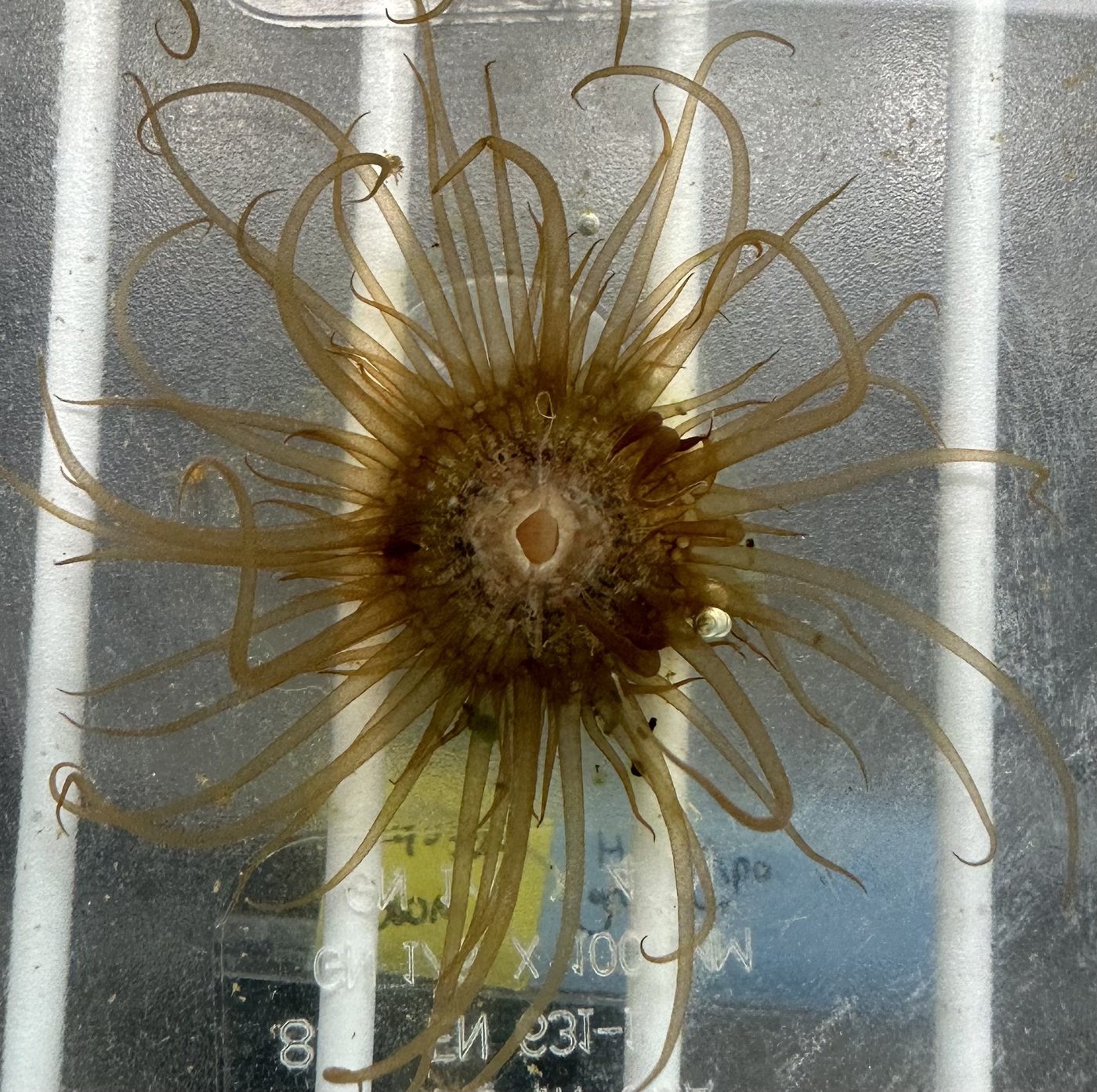
Exaiptasia diaphana
Sea anemone, a model for coral bleaching
- Methods
- Delay differential equations, Size-structured models, Generalized additive models, Identifiability
- Collaborators
- Sogin lab (UC Riverside), Kaden Muffett, Pablo Curiel, Suzanne Sindi, Shilpa Khatri, Erica Rutter
The question
The sea anemone Exaiptasia diaphana (often called Aiptasia) hosts the same family of symbiotic algae as reef-building corals, and bleaches under heat stress in the same way. Unlike corals, it grows quickly in the lab, reproduces clonally and can be kept without its algae. That makes it the leading laboratory model for predicting how corals will respond to warming.
What we found
With the Sogin lab at UC Riverside, I contributed data analysis and systematic image analysis to a study of two Exaiptasia lines under chronic heat stress. At 31.5 °C, a temperature often reached in coastal heatwaves:
- the heat-tolerant line (CC7) produced 73% more asexual clones;
- the heat-sensitive line (H2) reproduced 13% less;
- 16 low-abundance bacterial taxa shifted consistently before the host’s own physiology did.
Those rare bacteria are potential early-warning signals: indicators for an organism that is itself an indicator of reef health.
What I’m working on
Fitting a delay differential equation model of population growth suggests the sensitive line’s population departs from the rates measured in isolated adults, pointing to size-dependent mortality. I am now working out how this simpler model relates to a fully size-structured one, and what can be identified from count data alone. With Pablo Curiel, I am adding deep-learning image detection to collect the size data a full model needs.