Built with language models
I've been doing my best to keep up with modern LLM tools and to play around with them. They look like they're here to stay, given results announced this year such as OpenAI's Navier–Stokes blow-up proof and Yang–Mills existence proof, and the counterexample to the Jacobian conjecture found with Claude.
For research I take a much harder line. I've become a firm advocate for keeping a human in the loop and for extensive verification of anything an LLM produces for science. For learning what the tools can do, though, a low-stakes, relaxed approach can be very helpful.
Here are a few side projects I made by directing AI models, with different levels of intervention. Each card says what the thing is, how involved I was, and how it was made.
Projects

R-Naught
A turn-based pandemic strategy game on a stochastic SIRD model of 171 countries. Play the pathogen or the world's response, against the computer or a friend on the same device. Its Learn mode explains compartmental models and R0 at three levels.
My involvement: Low. I wrote the brief and made a handful of design calls from my phone along the way, such as clearer aims, region-level controls and turn-based play.
Built by Claude agents in one day, November 2026.
Open →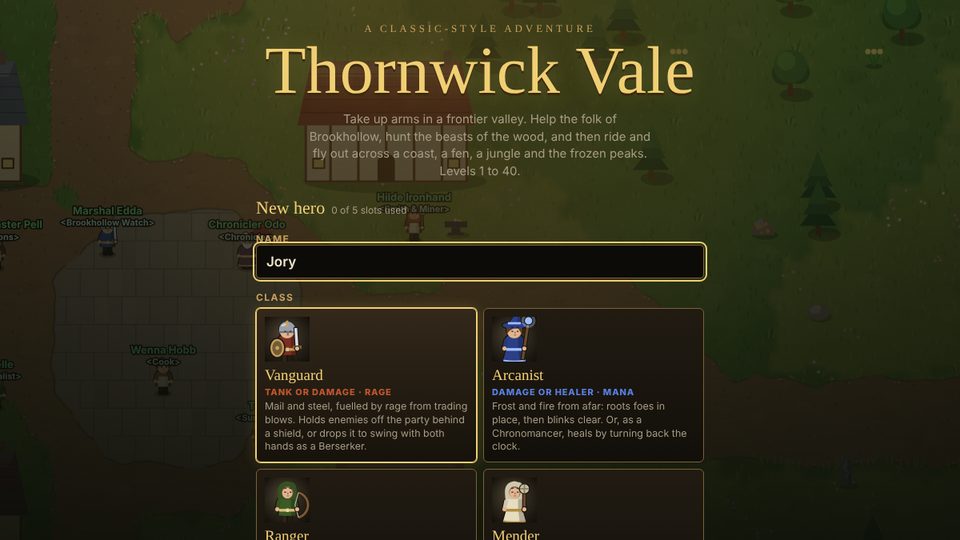
Thornwick Vale
A classic-style fantasy adventure that runs in one browser page. Pick one of seven classes, level from 1 to 40 across five zones with a party of AI companions, and clear five dungeons. Every character has written dialogue. Saves stay in your browser.
About 45,000 lines of JavaScript, built by Claude agents over four days in October 2026.
Open →These are experiments, not research outputs. Where one uses a scientific model, its own pages say what the model includes and what it leaves out.