Euprymna scolopes
Hawaiian bobtail squid
- Methods
- Computational fluid dynamics, Regularized Stokeslets, Sobol sensitivity analysis, Active Brownian motion
- Collaborators
- Elizabeth Heath-Heckman (Michigan State), Kyra Ruiz, Erica Rutter, Shilpa Khatri
The question
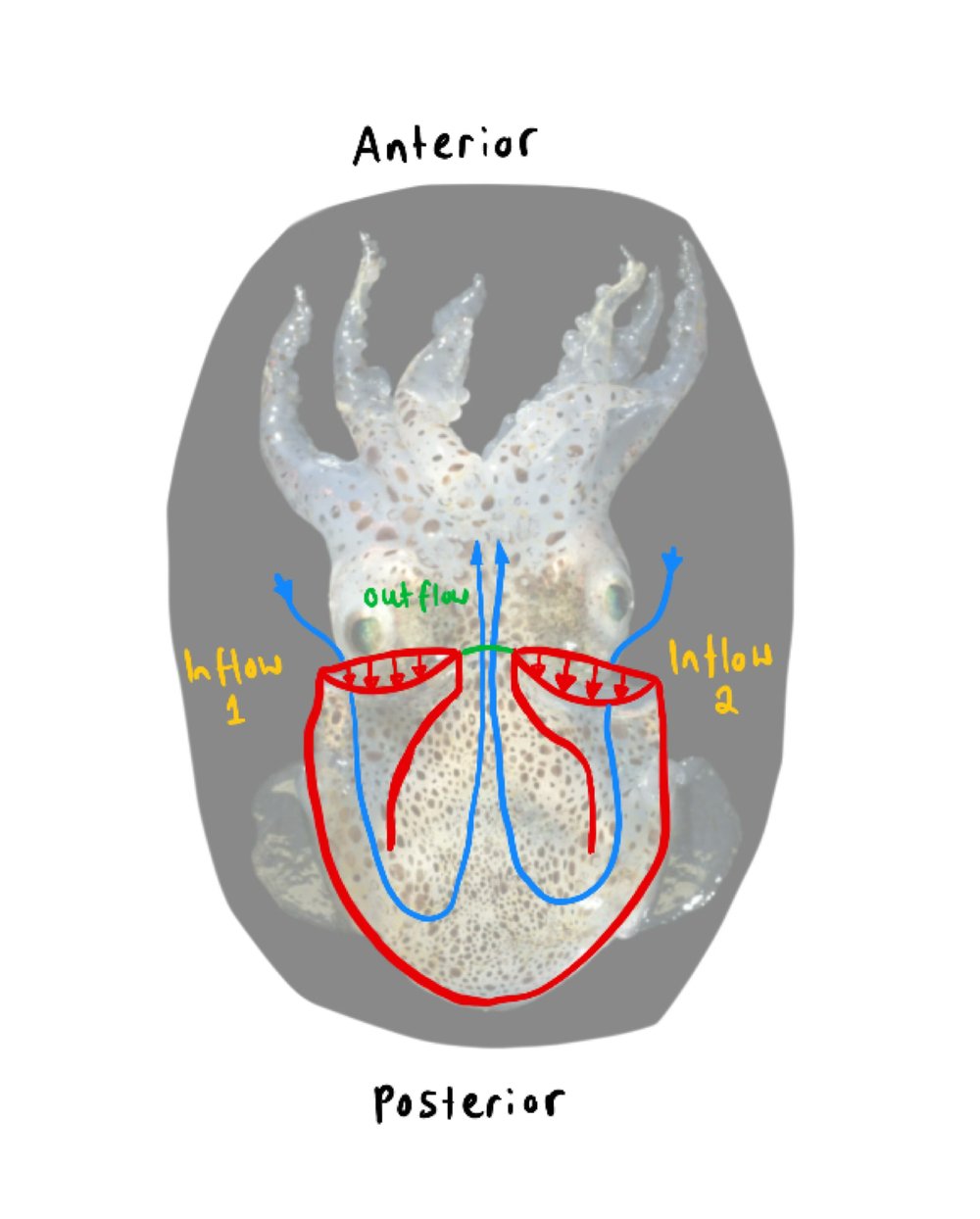
Within hours of hatching, the Hawaiian bobtail squid has to recruit the bioluminescent bacterium Vibrio fischeri from seawater. Bacteria are drawn into the squid’s mantle cavity by breathing, then captured by flows from cilia on the light organ, where they settle in for the squid’s lifetime [1]. Warming impairs this colonization [2], but where in the process the failure happens is not known.
What I built
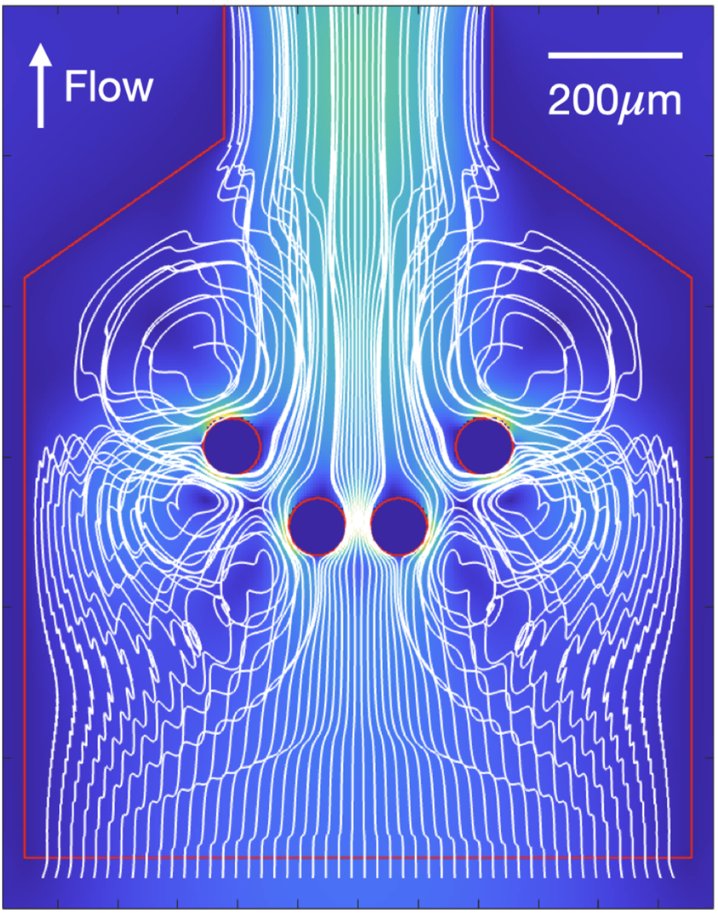
With the Heath-Heckman lab, I built a fluid-dynamics model of breathing-driven bacterial transport inside the squid, using the method of regularized Stokeslets. Varying breathing strength, breathing rate, ciliary beating and squid size across tens of thousands of simulations, I ran a Sobol sensitivity analysis to find which factors control how long bacteria spend near the light organ.
What we found
Breathing strength, breathing rate and squid size dominate how long bacteria stay near the light organ. The shallow, rapid breathing of heat-stressed squid can halve the time bacteria spend in the regions that matter for colonization, a purely physical route by which warming could weaken the symbiosis.
What’s next
- Extending the model to a realistic, deforming mantle cavity.
- Adding swimming and chemotaxis, since V. fischeri are not passive tracers. Does active swimming buffer recruitment against weakened breathing, up to a threshold temperature?
Try a simplified version of the flow method in the interactive Stokeslet demo.
Outputs
- Williams, S., Ruiz, K. A., Heath-Heckman, E., Rutter, E. M., Khatri, S. Thermal stress disrupts symbiotic fluid dynamics in bobtail squid. J. R. Soc. Interface 23, 20251136 (2026). Paper · Code
- Poster: MDDLS 2025 · Invited talk: AMS Western Sectional 2026
References
- Nawroth, J. C. et al. Motile cilia create fluid-mechanical microhabitats for the active recruitment of the host microbiome. PNAS 114, 9510–9516 (2017). doi:10.1073/pnas.1706926114
- Otjacques, E. et al. Global Change Biology (2025). doi:10.1111/gcb.70243