Chlamydomonas reinhardtii
Swimming microalga

- Methods
- Statistical physics, Active particles, Numerical simulation, Image analysis
- Collaborators
- Marco Polin (IMEDEA), Raphaël Jeanneret, Idan Tuval, Shilpa Khatri
The question
Many microbes live in mixtures: some swim, some don’t. When the swimmers bump into passive particles, they push them around, and in a confined space, like a microfluidic channel or a host’s tissues, those collisions can organize the whole suspension. How do swimmers redistribute the particles around them, and can we control it?
What I found
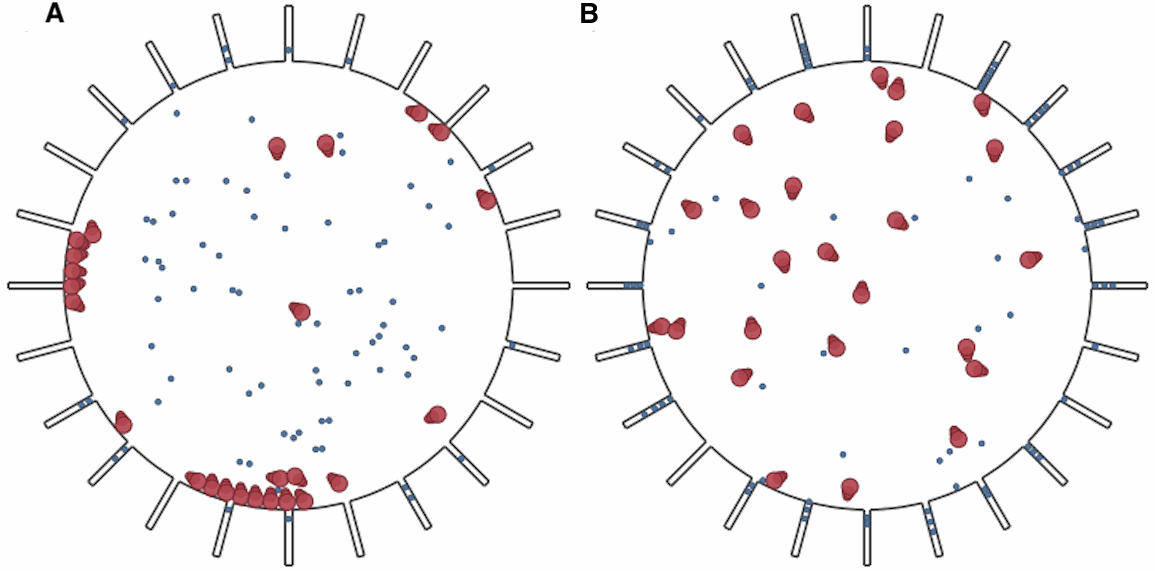
In my PhD with Prof. Marco Polin at the University of Warwick, I combined swimming Chlamydomonas reinhardtii with passive colloids in microfluidic channels. Confinement alone produced a non-monotonic colloid distribution, with a pronounced peak at the boundary. I captured this with a stochastic, space-dependent jump-diffusion model driven by the algae’s motion, and we used the effect to de-mix active–passive suspensions experimentally.
What’s next
I am generalizing these results to a broader class of microswimmers, showing how scattering events near a boundary control where passive particles end up. My squid research extends the same problem to a much more complex case: a boundary that is alive.
Outputs
- Williams, S., Jeanneret, R., Tuval, I., Polin, M. Confinement-induced accumulation and de-mixing of microscopic active–passive mixtures. Nature Communications 13, 4776 (2022). Paper · Code
- In preparation: Williams, S., Khatri, S., Polin, M. Controlling passive particle distributions in mixed systems through active scattering events.
- PhD thesis: Mixed Active–Passive Systems in Confinement, University of Warwick (2022).